Firefighter Physical Ability Test Requirements: What to Expect
Master the firefighter physical ability test requirements with our guide on events, time standards, and training plans to pass your PAT with confidence.

By Hyun Kim

Loading…
Career guides, job search notes, and education options from Careers.org. No account required.
Master the firefighter physical ability test requirements with our guide on events, time standards, and training plans to pass your PAT with confidence.
By Hyun Kim
You have completed the written exam, passed the interview panel, and cleared the background check. Now the final and often most intimidating hurdle stands between you and a recruit academy slot: the firefighter physical ability test, or PAT. This is not a general fitness test where you simply need to show up in decent shape. It is a job-task simulation designed to replicate the actual demands of fireground operations under controlled, timed conditions. Every component, from the charged hose drag to the ladder raise, is chosen because firefighters perform that exact action on real emergency scenes. Understanding the precise firefighter physical ability test requirements before your test date is not just helpful for peace of mind; it is essential for structuring your training and avoiding a disqualification that can set your career timeline back by months or even years.
Because the test is physically demanding and often pass-fail with strict time limits, candidates who treat it like a generic gym workout frequently fall short. The requirements vary by department, but the core structure is remarkably consistent across most of the United States. This guide breaks down the typical components, the time standards, the scoring methods, and the preparation strategies you need to clear your PAT with confidence. Whether you are applying to a large municipal department or a smaller district, the physical standard is designed to prove you can operate safely in a high-stress, high-heat environment while wearing heavy protective gear.
Most firefighter physical ability tests follow a continuous or station-based format that mimics a fireground scenario. In a continuous test, you move from one event to the next without stopping the clock, simulating the sustained exertion of firefighting. In a station-based test, you perform each task individually with short rest periods. Regardless of format, the events test the same fundamental physical capacities: cardiovascular endurance, upper body strength, grip strength, core stability, and lower body power. The most common events include the charged hose drag, equipment carry, ladder raise and extension, forcible entry, search and rescue, and the ceiling breach and pull.
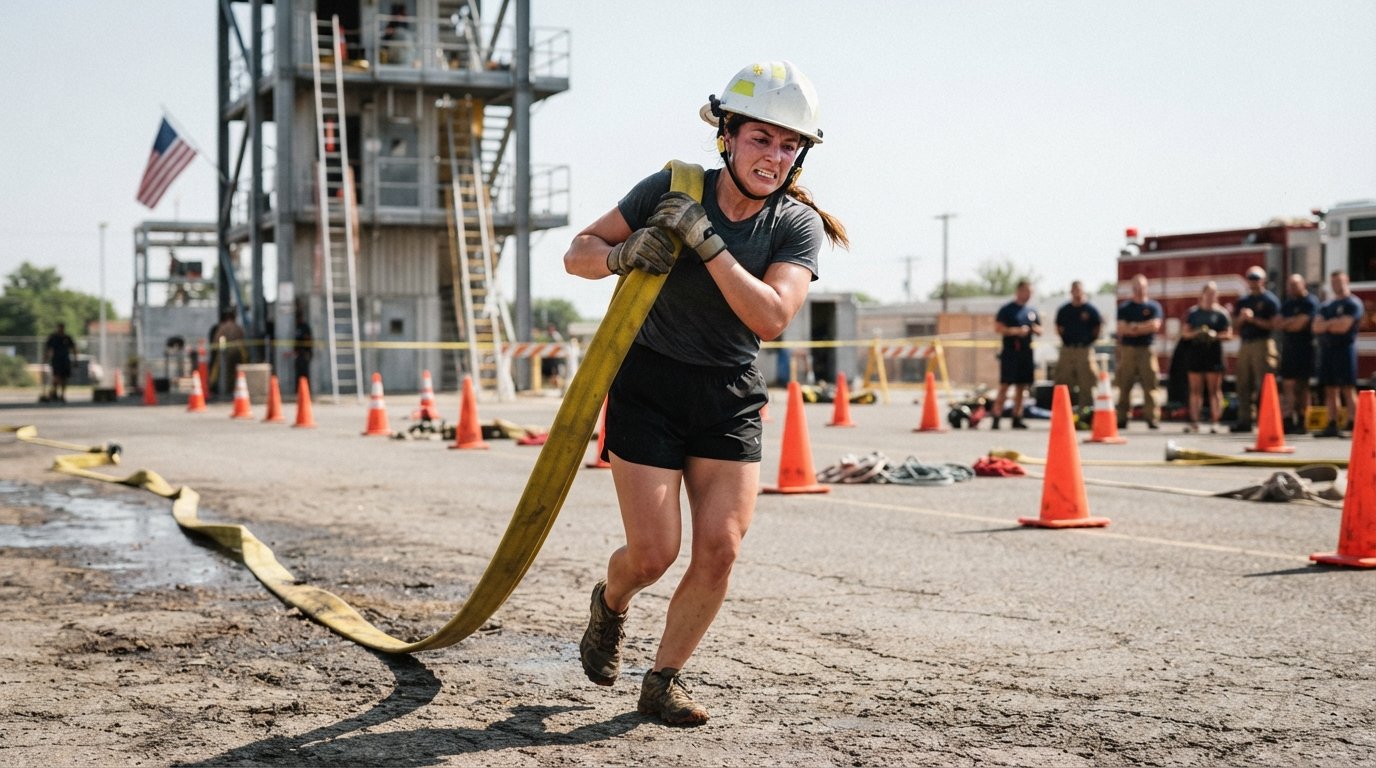
The charged hose drag and equipment carry test your ability to move heavy loads under resistance. You will typically drag a charged hose line 75 to 100 feet, then shoulder-carry a bundle of equipment such as a chainsaw or high-rise pack. The ladder raise requires you to lift a 24-foot extension ladder from the ground to a vertical position and extend it, which demands shoulder strength and coordination. Forcible entry uses a 10-pound sledgehammer to strike a target sled, testing explosive power and grip endurance. The search and rescue event, often the most taxing, requires you to crawl through a confined maze in full gear while dragging a 165-pound mannequin to safety. The ceiling breach and pull simulates pulling down a ceiling with a pike pole, testing upper body and core strength.
One of the most misunderstood aspects of firefighter physical ability test requirements is the time limit. Many candidates train for strength but ignore the clock, and that is a costly mistake. Most continuous PATs have a maximum completion time of 8 to 10 minutes, though some departments allow up to 12 minutes. The key word is continuous: the clock does not stop between events, and you are typically required to maintain a minimum pace. For example, the Candidate Physical Ability Test (CPAT), used by many departments nationwide, requires completion within 10 minutes and 20 seconds. Exceeding the time limit results in an automatic failure, regardless of how well you performed individual events.
Scoring methods fall into two categories: pass-fail and timed-scored. Pass-fail tests simply require you to complete the course within the maximum time. Timed-scored tests, common in larger departments, assign points based on how fast you finish, and your score may factor into your final hiring ranking. This means that even if you pass, a slow time could hurt your placement on the eligibility list. In some departments, the PAT is worth 20 to 30 percent of your overall score, alongside the written exam and oral board. Therefore, training for speed and efficiency, not just completion, is critical if you want to be competitive.
Beyond the clock, there are technical requirements that can cause disqualification. You must wear the provided personal protective equipment, typically a 50-pound vest or full turnout gear with a self-contained breathing apparatus (SCBA). Dropping equipment, failing to complete a task according to the evaluator's instructions, or missing a required hand placement can result in failure. Some tests also include a grip strength minimum, often around 100 to 120 pounds, and a minimum vertical jump or leg press standard. These are not typically part of the timed course but are measured separately as part of the overall physical qualification.
Training for the firefighter physical ability test requirements is not the same as training for a bodybuilding competition or a marathon. You need a hybrid of strength endurance, aerobic capacity, and functional movement under load. The most effective approach is a 12-week program that progressively overloads the specific movements you will perform. Start by building a base of cardiovascular fitness with 30 to 45 minutes of steady-state cardio three times per week, such as running or stair climbing. Then add two to three days of strength training focused on compound lifts: deadlifts, squats, overhead presses, and pull-ups. As you get closer to the test, shift toward high-intensity interval training and loaded carries.
Specificity is the key principle. If you want to be good at dragging a hose, you need to drag heavy things. If you want to be good at the ladder raise, you need to practice the movement pattern. Many fire departments and training academies offer practice sessions where you can run the actual course. Take advantage of these. If not, simulate the events at a gym: drag a weighted sled, carry heavy dumbbells, practice sled hammer strikes, and crawl through a low tunnel. Always train in the gear you will wear on test day, or a weighted vest that approximates it, to condition your body to the added load and heat stress.
Recovery and injury prevention are just as important as the work itself. The PAT has a high injury rate among unprepared candidates, particularly shoulder and lower back strains. Incorporate mobility work, foam rolling, and at least one full rest day per week. Hydration and nutrition also play a role: you cannot perform at your peak if you are dehydrated or under-fueled. Practice your test-day nutrition and hydration strategy during your final few simulations so you know what works for your body.
Even physically fit candidates fail the PAT, and the reasons are usually preventable. The most common pitfall is pacing. Many candidates sprint out of the gate on the first event, only to hit the wall during the search and rescue. The test is designed to be a grind, not a sprint. Start at a sustainable pace and aim to finish each event with a small reserve of energy. Another common mistake is neglecting grip strength. The hose drag, ladder raise, and sledgehammer all require a strong grip, and if your forearms fail, the rest of your body cannot compensate. Incorporate farmer's carries, dead hangs, and grip-specific exercises into your routine.
Another frequent error is improper technique. For example, on the ladder raise, using your back instead of your legs to lift the ladder can cause immediate injury or failure. On the hose drag, leaning too far forward can cause you to lose your footing. Practice each movement with a qualified trainer or experienced firefighter who can correct your form. Finally, do not ignore the mental component. The PAT is as much a test of grit as it is of muscle. Visualize the course, practice under simulated stress, and develop a pre-test routine that keeps you calm and focused. Candidates who have rehearsed the course mentally and physically are far more likely to pass.
While the CPAT provides a national standard, many departments use their own proprietary tests. Some may include additional events such as a dummy drag over a longer distance, a stair climb with a high-rise pack, or a confined space crawl with a blackout mask. Others may have different time limits or equipment weights. Therefore, you must obtain the specific requirements from the department you are applying to. This information is typically published in the job announcement or candidate orientation packet. If it is not, contact the recruitment office directly and ask for a detailed breakdown of the test events, time limits, and scoring criteria.
Additionally, some departments require a medical clearance and a physical examination before you can take the PAT. This may include an EKG, vision and hearing tests, and a general health screening. Failing to complete these prerequisites can disqualify you before you even step onto the course. Always read the entire application packet carefully and create a checklist of every requirement, including deadlines. For candidates who are also exploring educational pathways in public safety or criminal justice, resources like CollegeAndTuition can help you understand how degree programs might fit into your long-term career plan, though the PAT itself is a separate hiring requirement.
Passing the PAT is not the end of your physical training; it is the beginning. The firefighter physical ability test requirements are a baseline, not a peak. Once you are hired, you will attend a recruit academy that will push you even harder, and your probationary year will demand consistent fitness. The best strategy is to adopt a year-round training lifestyle that includes strength, cardio, mobility, and recovery. Many fire departments offer wellness programs and fitness incentives, and some even require annual fitness tests for continued employment. By treating fitness as a career-long commitment, you not only improve your chances of passing the initial test but also reduce your risk of injury on the job.
For those still in the exploration phase, consider how your educational background can complement your physical preparation. Earning a degree in fire science, emergency management, or public safety can strengthen your application and open up promotion opportunities later. Careers.org provides detailed guides on how to become a firefighter and the educational paths that support that goal, including online and campus programs. While the PAT is a physical hurdle, your overall candidacy is strengthened by a combination of education, experience, and fitness. Start your physical training early, stay consistent, and treat the test as a measurable milestone on your path to a rewarding public safety career.
This block is reserved for sponsored schools from the education listing partner. That connection is not set up for this site, so no school names, program offers, or request form can be shown.