
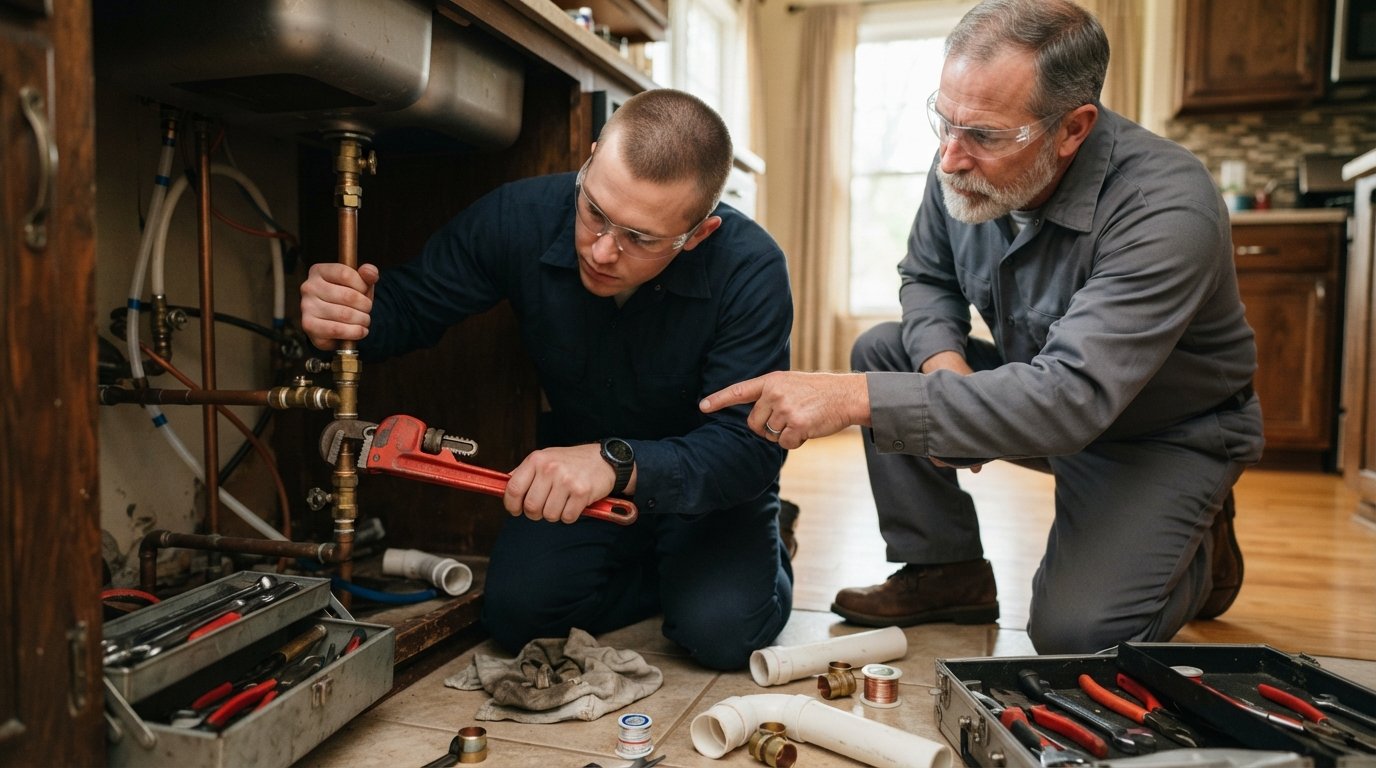
Plumbing Apprenticeship Requirements: A 2026 Career Guide
Meet the plumbing apprenticeship requirements and start a paid career in the skilled trades with no four-year degree needed.

By Lina Nazari
Plumbing is one of the most stable and well-paid skilled trades in the United States, and demand for qualified plumbers continues to grow as aging infrastructure and new construction projects create steady work. But unlike many careers, plumbing does not require a four-year degree. Instead, the most common and respected path into the trade is through a formal apprenticeship, a paid training program that combines on-the-job experience with classroom instruction. Understanding the plumbing apprenticeship requirements is the first step toward a rewarding career that offers job security, a living wage from day one, and the chance to run your own business later on.
Whether you are a high school student planning your next move, a working adult considering a career change, or a veteran looking for a skilled trade, the requirements are more accessible than many people expect. This guide breaks down the core requirements, the application process, and the steps you can take to stand out as a candidate. It also explains how related training and education programs can strengthen your application and prepare you for the journeyman exam down the road.
What Are the Core Plumbing Apprenticeship Requirements?
At a minimum, most plumbing apprenticeship programs require applicants to be at least 18 years old, have a high school diploma or GED, be physically able to perform the work, and pass a basic math and aptitude test. Some programs also require a valid driver's license and a clean background check. These baseline requirements are fairly consistent across union and non-union programs, though individual sponsors may add their own criteria.
Here is a closer look at the standard requirements you will encounter when applying to a plumbing apprenticeship:
- Age: You must be at least 18 years old. Some programs allow 17-year-olds to apply if they will turn 18 before the start date.
- Education: A high school diploma or GED is almost always required. Some programs accept equivalent credentials or completion of a pre-apprenticeship program.
- Math and aptitude: You will likely need to pass a test covering basic arithmetic, measurement, and mechanical reasoning. Algebra and geometry skills are helpful.
- Physical ability: Plumbing involves lifting, climbing, crawling, and working in tight spaces. You may need to pass a physical exam or demonstrate the ability to perform essential job functions.
- Driver's license: Many employers require a valid license and reliable transportation to reach job sites.
- Background check and drug screening: Common in both union and non-union programs, especially for work on commercial or government projects.
Beyond these basics, competitive programs may look for prior work experience, vocational training, or completion of a pre-apprenticeship course. The more preparation you can show, the stronger your application will be. Keep in mind that requirements can vary by state and by program sponsor, so always check the specific criteria for the apprenticeship you are targeting.
How to Apply for a Plumbing Apprenticeship
The application process for a plumbing apprenticeship is straightforward but competitive. Most programs open applications on a set schedule, and some have waiting lists. The key is to prepare early and submit a complete, polished application. Here is a step-by-step overview of how the process typically works.
- Research local programs: Identify apprenticeship programs in your area through trade unions, contractor associations, community colleges, and state apprenticeship agencies. The U.S. Department of Labor's apprenticeship database is a good starting point.
- Meet the prerequisites: Ensure you have your diploma or GED, a valid driver's license, and any required test scores. If you need to brush up on math, consider a refresher course.
- Prepare your application materials: Gather your resume, transcripts, references, and any certifications. A clean, professional resume that highlights reliability and hands-on experience helps.
- Take the aptitude test: Many programs require an entrance exam covering math, reading comprehension, and mechanical aptitude. Practice tests are available online and through local libraries.
- Interview: If you pass the test, you may be invited to an interview. Be ready to discuss your work ethic, interest in the trade, and long-term goals.
- Accept an offer and register: Once accepted, you will typically sign an apprenticeship agreement and begin your paid training.
Because apprenticeship slots are limited, it pays to apply to multiple programs and to follow up professionally. Some sponsors give preference to applicants who have completed a pre-apprenticeship program or have relevant work experience. Showing that you understand the trade and are committed to it can make a real difference.
Education and Training That Strengthen Your Application
While a high school diploma is the minimum, additional education can give you an edge. Many community colleges and trade schools offer plumbing technology certificates and associate degrees that cover plumbing theory, code, blueprint reading, and safety. These programs can also count toward apprenticeship hours or help you prepare for the journeyman exam. For students who need financial assistance, resources like Scholarship.Education can help identify scholarships and financial aid opportunities for trade and technical programs.
Pre-apprenticeship programs are another excellent option. They are typically short, hands-on courses that introduce you to basic plumbing skills and safety practices. Completing one demonstrates your commitment and can sometimes exempt you from certain entrance requirements or give you advanced standing. If you are still in high school, consider vocational classes or a career and technical education (CTE) track that includes plumbing or construction trades.
For those who prefer online learning, some plumbing theory and code courses are available online, though hands-on training is essential for the trade. A hybrid approach, combining online coursework with in-person labs, can be a flexible way to prepare. When researching programs, check accreditation and whether the program is recognized by local apprenticeship sponsors.
Union vs. Non-Union Apprenticeships
Plumbing apprenticeships come in two main flavors: union and non-union (often called open shop or merit shop). Both lead to journeyman status, but they differ in structure, pay, and benefits. Understanding the differences can help you choose the right path.
- Union apprenticeships: Sponsored by organizations like the United Association (UA) and local plumbing unions, these programs typically offer structured classroom instruction, a clear pay scale, and strong benefits. They often have competitive entry and may require you to join the union.
- Non-union apprenticeships: Sponsored by individual contractors or trade associations, these programs vary widely in quality and structure. They may offer more flexibility and faster entry, but benefits and job placement support can differ.
Both paths require similar core qualifications and lead to the same journeyman license in most states. The best choice depends on your local job market, your career goals, and the specific opportunities available. It is worth applying to both types to maximize your chances.
Key Skills and Qualities Employers Look For
Beyond the formal requirements, apprenticeship sponsors look for candidates who have the right mix of skills and personal qualities. Plumbing is a customer-facing trade, so communication and professionalism matter as much as technical aptitude. Here are some of the traits that can set you apart.
- Mechanical aptitude: Comfort with tools, measurements, and basic physics.
- Math skills: Ability to calculate measurements, angles, and pipe lengths.
- Physical stamina: Plumbing can be demanding, so endurance and strength are important.
- Problem-solving: Diagnosing issues and finding efficient solutions.
- Reliability: Showing up on time and following through on commitments.
- Communication: Explaining problems and solutions clearly to customers and teammates.
You can develop many of these skills through prior work, volunteering, or vocational training. Even a summer job in construction or maintenance can provide useful experience and references.
Apprenticeship Duration and Career Progression
A plumbing apprenticeship typically lasts four to five years, depending on the program and state requirements. During that time, you will work full-time under the supervision of experienced plumbers and complete a set number of classroom hours. Apprentices earn a percentage of a journeyman's wage, with pay increasing as you gain experience and complete training milestones.
Upon completion, you become a journeyman plumber and can work independently. Many plumbers eventually pursue a master plumber license, which allows them to supervise others, pull permits, and start their own businesses. The career ladder is clear: apprentice, journeyman, master. Each step brings higher pay and more responsibility.
For those interested in related paths, plumbing experience can lead to careers in pipefitting, steamfitting, or construction management. The skills you learn are transferable and in demand across the country.
Common Misconceptions About Plumbing Apprenticeships
There are several myths about plumbing apprenticeships that can discourage potential applicants. One common misconception is that you need prior experience to get started. In reality, most programs are designed for beginners and provide all the training you need. Another myth is that apprenticeships are unpaid or low-paying. In fact, apprentices earn a paycheck from day one, and the pay is often comparable to entry-level jobs in other fields.
Some people also believe that plumbing is a dead-end job. That could not be further from the truth. Plumbers can advance to supervisory roles, start their own companies, or specialize in areas like medical gas, green plumbing, or industrial systems. The trade offers a clear path to entrepreneurship and high earnings for those who pursue it.
Finally, many assume that apprenticeships are only for young people. In reality, apprenticeship programs welcome career changers and veterans, and the skills you develop are valued at any age. If you are considering a switch, your life experience and work ethic can be a major asset.
Next Steps: Launching Your Plumbing Career
If you are ready to pursue a plumbing apprenticeship, start by researching programs in your area and confirming the specific requirements. Reach out to local unions, contractors, and community colleges to learn about upcoming application windows. Prepare for the aptitude test by brushing up on math and mechanical reasoning, and consider a pre-apprenticeship course to strengthen your application.
Education and training can make a big difference in your success. Whether you choose a certificate program, an associate degree, or a pre-apprenticeship, the knowledge you gain will serve you throughout your career. And as you plan your training, keep in mind that financial aid and scholarships are available for trade students. With the right preparation and a strong work ethic, you can meet the plumbing apprenticeship requirements and start building a stable, rewarding career in the skilled trades.
Sponsored school listings are unavailable
This block is reserved for sponsored schools from the education listing partner. That connection is not set up for this site, so no school names, program offers, or request form can be shown.