
FAA Academy Training Explained: Air Traffic Careers
FAA Academy training explained: how controllers are hired, trained, and paid, plus what it takes to succeed in Oklahoma City.

By Rahul Iyer
Careers in aviation span far beyond the cockpit. Behind every safe takeoff and landing, an intricate network of air traffic controllers, technicians, and safety inspectors keeps the system running. For many people drawn to aviation, the Federal Aviation Administration (FAA) Academy is the gateway to those roles. But what actually happens at the FAA Academy, who gets in, and how does the training prepare you for a real job? This guide breaks down the FAA Academy training explained in practical terms, from application to graduation, so you can decide whether this path fits your career plans.
What Is the FAA Academy and Who Attends?
The FAA Academy is the agency's primary training institution, located at the Mike Monroney Aeronautical Center in Oklahoma City. It is not a college or a general aviation school. Instead, it is a federal training facility that prepares new hires for specific FAA jobs, most notably air traffic controllers but also airway transportation systems specialists, aviation safety inspectors, and other technical staff. The Academy is where classroom instruction meets simulation, and where the FAA evaluates whether a candidate has the aptitude and temperament for the job.
The majority of students at the Academy are air traffic controller trainees, often called developmental controllers. These individuals have already been hired by the FAA, usually through a competitive bid process or a specialized program for students at FAA-approved Collegiate Training Initiative schools. Attending the Academy is not the same as applying to a college; you must be hired first. That distinction matters because the Academy is a job training environment, not a degree program. Trainees are federal employees from day one, and successful completion of Academy training is a condition of continued employment.
Other attendees include technicians who maintain radar, communications, and navigation equipment, as well as safety professionals who inspect aircraft and carriers. Each role has its own course track and duration, but all share the same rigorous, standardized approach to training. The common thread is that the FAA Academy exists to ensure every graduate can perform safely and consistently in a high-stakes environment.
The Air Traffic Controller Training Path
For aspiring controllers, the training path is the most well-known and the most demanding. It begins with the FAA's hiring process, which includes an application, a biographical assessment, and a comprehensive aptitude test known as the Air Traffic Skills Assessment (ATSA). Candidates who pass are placed in a hiring pool and, if selected, receive a tentative offer and a date to report to Oklahoma City. Before arriving, they must complete a medical exam, security clearance, and drug screening. Only then does the actual Academy training begin.
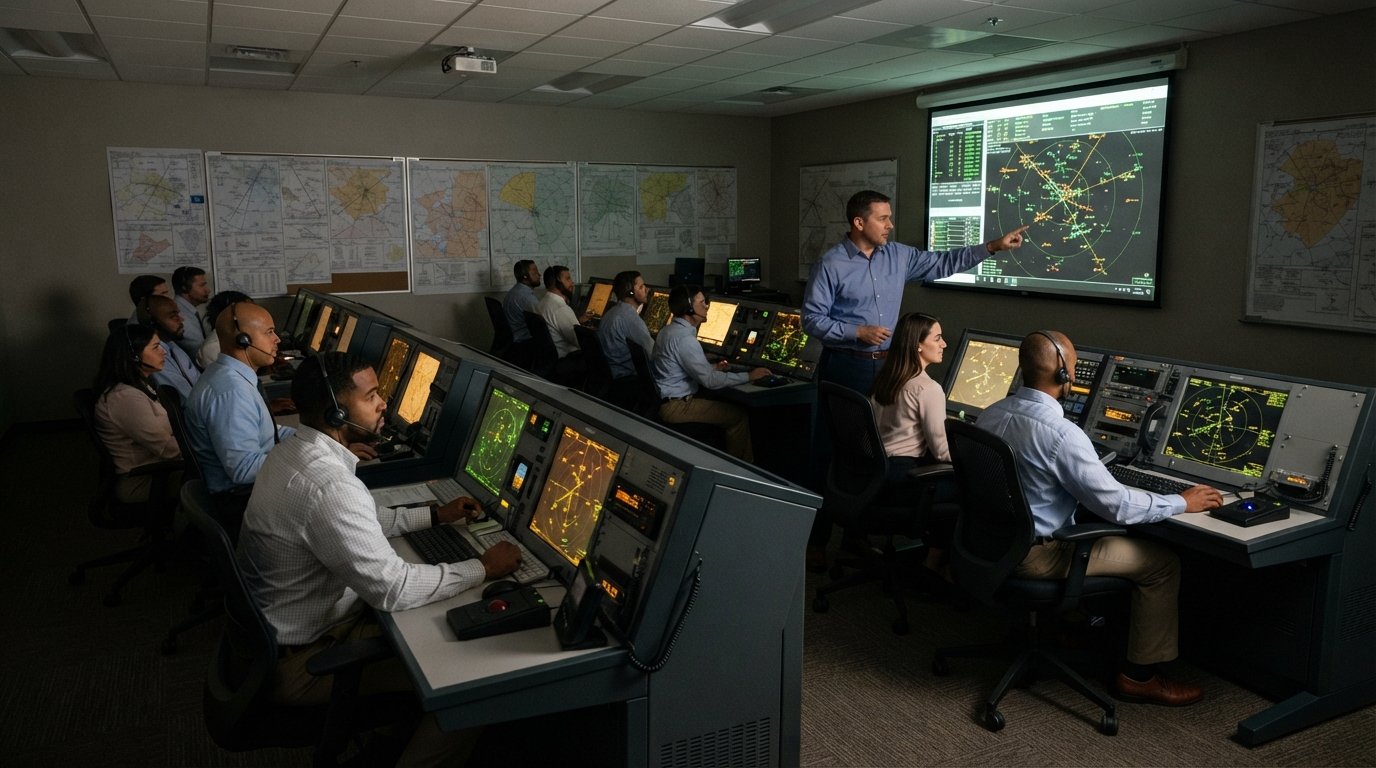
At the Academy, controller trainees go through several phases. The first phase is basic air traffic control fundamentals, covering rules, procedures, and the national airspace system. The second phase introduces simulation training, where trainees practice controlling traffic in realistic scenarios. The final phase is often the most challenging: a series of performance-based evaluations that mimic the pace and pressure of live traffic. Trainees must pass these evaluations to progress. The entire process typically takes several months, though the exact length depends on the specialty (terminal, en route, or flight service) and individual progress.
It is important to understand that Academy training is only the beginning. After graduating, controllers are assigned to a facility and enter on-the-job training (OJT), which can last from one to three years. During OJT, they work with certified controllers and gradually take on more responsibility. The Academy provides the foundation, but the real learning happens at the facility. This layered approach is one reason the FAA Academy is respected worldwide: it combines standardized classroom instruction with hands-on simulation before anyone touches live traffic.
Admission Requirements and How to Prepare
Getting into the FAA Academy is not a matter of simply enrolling. The FAA hires controllers through periodic open announcements, and competition is stiff. To be eligible, candidates generally need to be U.S. citizens, be under the age of 31 at the time of application (for controller positions), pass a medical exam, and meet education or experience requirements. A bachelor's degree or a combination of education and work experience is typically required, though the FAA has specific pathways for veterans and graduates of approved collegiate training programs.
Preparation for the Academy starts well before you arrive. The ATSA is a computer-based test that measures spatial reasoning, memory, and multitasking, and it is not something you can cram for. Practice tests and familiarization materials are available, but the best preparation is a genuine interest in aviation and a track record of handling complex, fast-paced tasks. Once hired, trainees are advised to study the basics of air traffic control, including phraseology and airspace classification, before reporting to Oklahoma City. The Academy moves quickly, and arriving with foundational knowledge can make the difference between passing and washing out.
For those who are still exploring aviation careers, it helps to understand the broader landscape of public safety and emergency response roles. Our guide on wildland firefighter jobs explained covers another demanding public service path that shares similarities in terms of physical requirements, teamwork, and shift work. Comparing these roles can help you decide which environment suits you best.
Life at the Academy: What to Expect Day to Day
Life at the FAA Academy is structured and intense. Trainees typically attend classes five days a week, with a mix of lectures, computer-based instruction, and simulator sessions. The days are long, and the material is cumulative, meaning that falling behind in one area can affect performance in another. Instructors are experienced controllers and technicians who bring real-world perspective, but they also hold trainees to exacting standards. The atmosphere is professional and focused, with little room for distractions.
Beyond the classroom, trainees must adapt to a new city, often far from home. Oklahoma City is affordable and manageable, and the FAA provides lodging and per diem for many trainees. Still, the transition can be stressful, especially for those who have never lived away from family or who are switching careers mid-life. Building a routine, forming study groups, and using the Academy's resources (including tutoring and extra simulator time) are common strategies for success. The FAA also emphasizes safety and professionalism, and trainees are expected to conduct themselves accordingly both on and off duty.
One of the most valuable aspects of Academy life is the peer network. Trainees come from all walks of life: recent college graduates, military veterans, and career changers from fields as diverse as retail and engineering. That diversity is a strength, and many graduates maintain connections with their Academy classmates throughout their careers. The shared experience of surviving the Academy creates a bond that lasts.
Cost, Compensation, and Career Outcomes
One of the most attractive features of FAA Academy training is that it is not a traditional educational program with tuition. Trainees are paid federal employees during training, and the FAA covers many of the associated costs, including travel and lodging in many cases. This means you are earning a salary and benefits while you learn, rather than taking on student debt. For career changers who are wary of expensive retraining programs, that is a significant advantage.
After graduation, controllers are placed at facilities across the country and begin OJT. Salaries for certified controllers are competitive, and the career ladder offers regular increases. However, it is important to note that not everyone completes the program. The washout rate at the Academy and during OJT is real, and the FAA does not guarantee placement if a trainee fails to meet standards. This is not a path for someone who wants a guaranteed outcome with minimal effort. It rewards those who are resilient, detail-oriented, and able to perform under pressure.
For those who are considering a career in aviation but are not sure about air traffic control, the FAA Academy also trains technicians and safety inspectors. These roles have different requirements and training timelines, but they share the same federal employment framework and the same emphasis on safety. If you are exploring federal careers more broadly, our article on procurement careers explained offers a look at another government hiring path with its own training and advancement structure.
How FAA Academy Training Compares to Other Education Paths
Prospective students often ask how FAA Academy training compares to a college degree or a private aviation school. The key difference is that the Academy is job-specific and employer-driven. A college program in aviation management or air traffic control may provide a broad education, but it does not guarantee a job with the FAA. The Academy, by contrast, is only available to those who have already been hired. It is a closed pipeline, not an open enrollment institution.
That said, some colleges and universities have FAA-approved Collegiate Training Initiative (CTI) programs that can improve a candidate's chances of being hired. These programs provide foundational knowledge and can help students prepare for the ATSA. But they are not a substitute for the Academy itself. Students who are interested in aviation careers should research CTI schools and consider whether a degree in aviation or a related field aligns with their goals. It is also wise to explore scholarship opportunities to reduce the cost of any college coursework. Resources like Scholarship.Education can help students find and evaluate financial aid options before committing to a program.
For those who are not selected for the FAA Academy, there are other paths into aviation, including private air traffic control training, military service, and roles in airport operations. Each has its own training requirements and career prospects. The FAA Academy is simply one route, albeit a prestigious and well-defined one, for those who meet the criteria.
Key Takeaways for Prospective Trainees
Understanding FAA Academy training explained in practical terms is the first step toward deciding whether it is right for you. The Academy is not a school you apply to directly; it is a training facility for FAA employees. The hiring process is competitive, and the training is demanding. But for those who succeed, it offers a stable, well-compensated career in one of the most critical safety systems in the world.
If you are considering this path, start by researching the current hiring announcements on the FAA's website and familiarizing yourself with the ATSA. Talk to people who have been through the process, and be honest with yourself about your ability to handle high-pressure, detail-oriented work. The Academy rewards preparation and perseverance. It is not for everyone, but for the right person, it is a life-changing opportunity.
Finally, remember that careers in aviation are not limited to controllers. The FAA and the broader industry need technicians, inspectors, planners, and managers. Whether you are drawn to the control tower or to the maintenance hangar, there is a training path for you. The key is to understand the requirements, prepare thoroughly, and commit to the process. The FAA Academy is one of the best examples of how focused, employer-driven training can lead to a meaningful career.
Sponsored school listings are unavailable
This block is reserved for sponsored schools from the education listing partner. That connection is not set up for this site, so no school names, program offers, or request form can be shown.