Careers in Disaster Response: Roles, Pay, and Paths
Explore careers in disaster response, from emergency management to public health roles, with salary ranges, education paths, and practical steps to get started.

Loading…
Career guides, job search notes, and education options from Careers.org. No account required.
Explore careers in disaster response, from emergency management to public health roles, with salary ranges, education paths, and practical steps to get started.
When a hurricane makes landfall, a wildfire forces thousands to evacuate, or an earthquake levels a city block, a small army of professionals moves toward the danger while everyone else moves away. These are the people who staff emergency operations centers, coordinate shelters, restore power, deliver medical care, and help communities rebuild. If you have ever watched a disaster unfold on the news and felt a pull to be part of the solution rather than a spectator, a career in disaster response may be worth exploring. The field is broader than most people realize, spanning emergency management, public health, fire and rescue, humanitarian logistics, and community recovery. It also offers a rare combination of job stability, clear pathways for advancement, and the kind of daily purpose that few other industries can match.
What makes this field especially attractive right now is that demand is not tied to a single employer or a single region. Every state has an emergency management agency, every large city has a public health department, and every hospital has a preparedness coordinator. Nonprofits, utilities, insurers, and private consulting firms all hire people with disaster response skills. That diversity of employers means you can enter the field from many different educational backgrounds, and you can move between public, private, and nonprofit sectors as your career evolves. The sections below break down the main job families, the education and credentials each one requires, salary expectations, and practical steps for getting started.
Disaster response is not a single job. It is an ecosystem of roles that activate before, during, and after a crisis. The work generally falls into four phases: mitigation, preparedness, response, and recovery. Some professionals specialize in one phase, while others rotate across all four. A mitigation specialist might spend years mapping floodplains and updating building codes. A preparedness coordinator writes evacuation plans and runs drills. A responder deploys to the field when an event occurs. A recovery manager helps communities access federal aid and rebuild infrastructure.
Because the field is so varied, the day-to-day experience differs dramatically by role. An emergency management director in a rural county might spend most of the year on planning and grant administration, with occasional activations during severe weather. A FEMA reservist might be deployed for months at a time to different parts of the country. A hospital preparedness coordinator works inside a healthcare system, ensuring that surge plans and supply chains hold up under pressure. Understanding this variation is the first step in choosing a path that fits your temperament, lifestyle, and career goals.
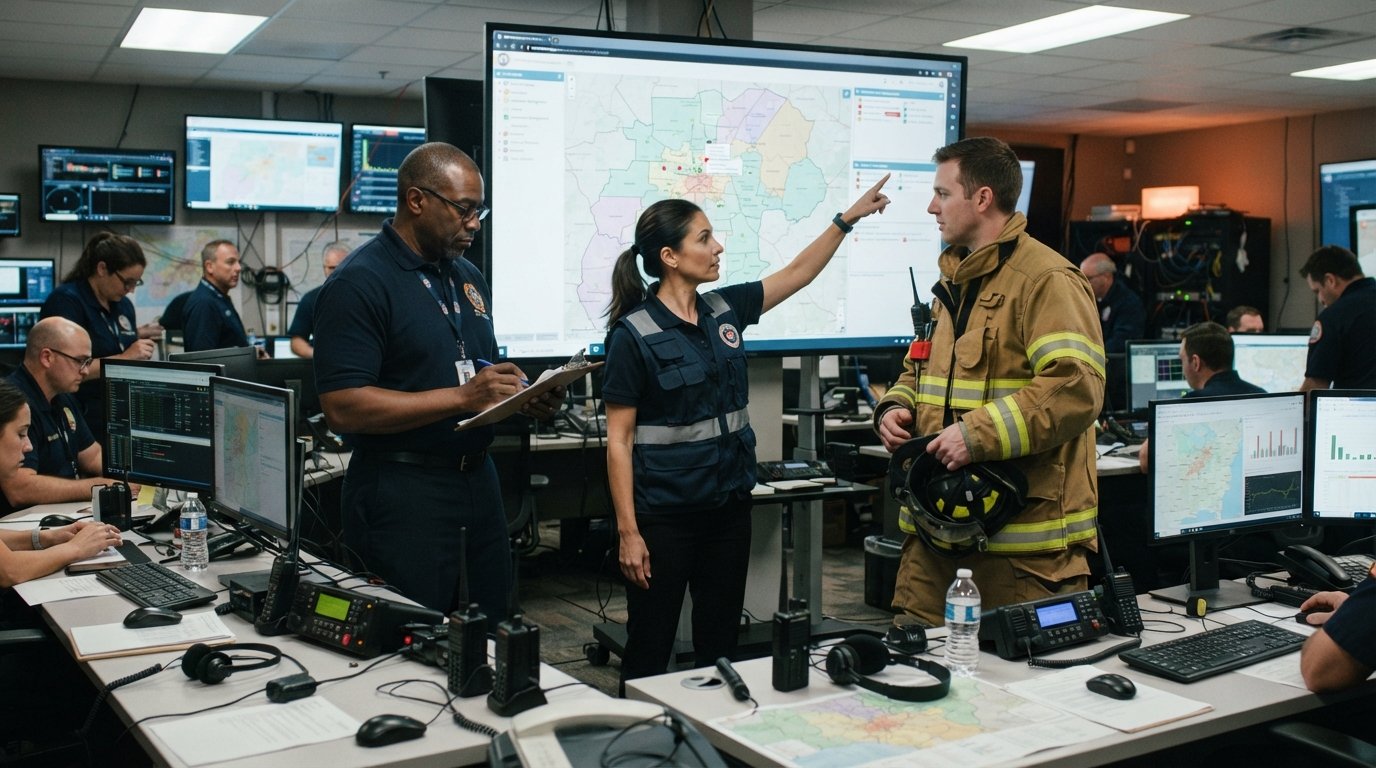
It also helps to know that disaster response is a team sport. No single person manages a major incident alone. Emergency operations centers bring together representatives from fire, law enforcement, public works, public health, utilities, and nonprofits. Communication, coordination, and calm decision-making under pressure matter more than physical stamina in many roles. If you thrive in structured, high-stakes environments and enjoy solving logistics puzzles with other people, you will likely find the work satisfying.
Most careers in disaster response cluster into a handful of job families, each with its own entry points and salary ranges. The figures below are approximate national averages and vary by location, experience, and sector. They are intended to give you a realistic sense of what to expect, not a guarantee of earnings.
Notice that the salary range is wide, and that is intentional. A planning-focused role in a stable government office looks very different from a field deployment role with unpredictable hours. The highest-paying positions tend to require either significant experience, advanced degrees, or specialized technical skills such as geographic information systems, cybersecurity, or engineering. Entry-level candidates should focus first on getting into the field, then on building credentials that unlock higher-paying specialties.
It is also worth noting that many disaster response jobs come with strong benefits, pension systems, and job security, particularly in the public sector. Those advantages can make a moderate salary more attractive than a higher private-sector figure with fewer protections. When comparing offers, look at total compensation rather than base pay alone.
There is no single degree that guarantees a career in disaster response, which is good news for people entering the field from different backgrounds. That said, certain educational paths are more direct than others. Emergency management, public health, homeland security, and public administration are the most common majors for people who want to specialize in preparedness and coordination. Fire science and paramedicine programs prepare people for direct response roles. Engineering, logistics, and information technology degrees open doors to the technical and planning sides of the field.
For students weighing their options, it helps to think about the level of education each role requires. Many entry-level positions in emergency management accept a bachelor's degree in a related field, while director-level roles increasingly prefer a master's degree. Fire and emergency medical roles typically require specialized academy training and state certification rather than a four-year degree, though advancement into leadership often involves additional coursework. Nonprofit and humanitarian roles vary widely, with some emphasizing experience and language skills over formal credentials.
Cost is a real consideration for anyone planning a career change. Prospective students should compare program costs, financial aid options, and completion timelines before committing. Resources that explain tuition, scholarships, and aid processes can make the decision more manageable, and sites such as CollegeAndTuition offer guidance on navigating higher education costs. It is also smart to check whether a program is offered online, since many working adults pursue emergency management degrees part-time while keeping their current jobs.
Beyond degrees, certifications carry significant weight in this field. The most widely recognized include FEMA's Independent Study courses, the Certified Emergency Manager credential, and state-specific emergency management certifications. For fire and medical roles, the relevant certifications are issued by state agencies and national boards. These credentials are often inexpensive and can be completed online, making them an efficient way to strengthen a resume before or during a job search.
The most common question from people interested in careers in disaster response is simple: how do I get my first job when every posting seems to require experience? The answer is that experience in this field often comes through volunteering, internships, and part-time roles rather than a traditional first job. Local emergency management agencies frequently rely on volunteer reservists. The Red Cross and other nonprofits train volunteers for shelter operations, casework, and logistics. Campus emergency teams and community emergency response teams offer hands-on exposure with minimal commitment.
A practical sequence for breaking in looks like this:
This sequence is not rigid, and many people enter the field through adjacent routes. Firefighters, paramedics, nurses, and military veterans often transition into emergency management roles because their operational experience translates directly. If you are considering a related public safety path, our guide to wildland firefighter jobs on the fireline explains how seasonal fire work can serve as a stepping stone into broader disaster response careers. Similarly, people with analytical or security backgrounds sometimes move into intelligence and risk roles that support disaster planning, and our article on careers in intelligence without military experience covers how to make that transition without a prior service record.
Once you are in the field, the key to advancement is specialization combined with breadth. The professionals who rise fastest tend to develop deep expertise in one area, such as mass care, infrastructure recovery, or hazard mitigation, while still understanding how the whole system fits together. Specializing makes you valuable during activations and gives you a clear identity in the job market. Breadth makes you promotable, because leadership roles require coordinating across disciplines.
Another long-term consideration is the rhythm of the work. Some roles involve frequent travel and extended deployments, which can be difficult for people with family obligations. Others are primarily office-based and predictable. It is entirely possible to build a stable, family-friendly career in disaster response by focusing on planning, policy, training, or resilience roles rather than field deployment. Many professionals move from field response into planning and leadership as they gain experience, trading adrenaline for influence and stability.
Finally, keep an eye on emerging specialties. Climate adaptation, cyber resilience, supply chain security, and community health preparedness are all growing areas that draw on disaster response skills. Professionals who position themselves at these intersections early often find more opportunities and higher pay than those who stay in traditional lanes. The field rewards continuous learning, and the people who treat their careers as a long-term project rather than a single job tend to do best.
Careers in disaster response offer something increasingly rare: work that matters, demand that is not going away, and multiple entry points for people with different backgrounds and constraints. Whether you are a student choosing a major, a working adult considering a career change, or a first responder looking to move into coordination and planning, there is a path that fits. Start with the free courses, volunteer for a local organization, and compare programs that match your budget and schedule. The need for prepared, capable professionals is only growing, and the right first step is closer than you think.
This block is reserved for sponsored schools from the education listing partner. That connection is not set up for this site, so no school names, program offers, or request form can be shown.